
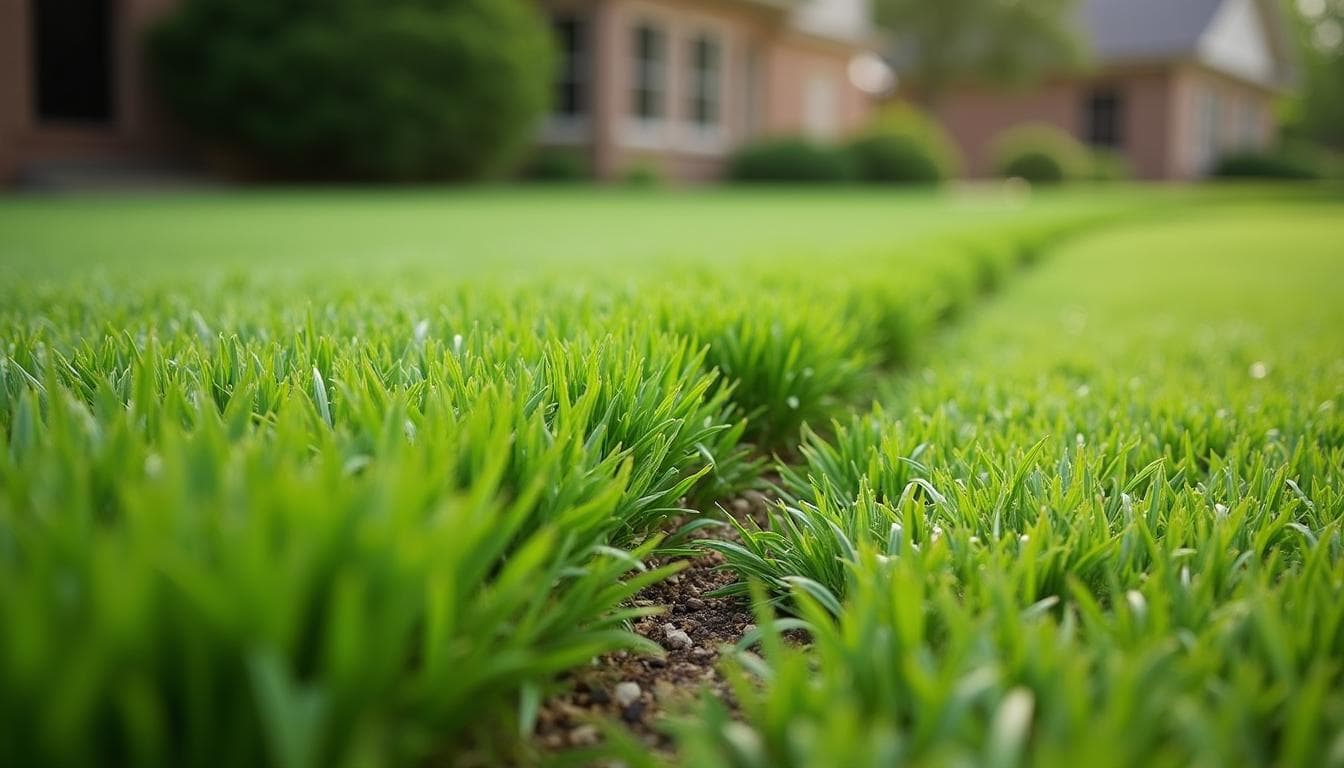
Most struggling lawns in this region are not suffering from a disease, a pest, or a nutrient deficiency. They are being cut at the wrong height, and everything else that looks wrong is downstream of that.
It is a genuinely consequential decision and almost nobody makes it deliberately. Deck height gets set once, to whatever seemed reasonable, and then it never changes — even when the grass type does.
The one-third rule, which is not optional
Never remove more than a third of the blade in a single cut. This is the foundational rule of mowing and it is broken constantly here, because Coastal Bend grass in June grows fast enough that two weeks between cuts guarantees you are taking half.
When you remove too much at once, the plant loses the leaf area it uses to photosynthesize and has to spend stored root reserves rebuilding it. Do that repeatedly and the root system gets progressively shallower, which is exactly when the lawn stops surviving a dry week. The yellow, stressed look people blame on heat is usually this.
Practically: weekly from March through October, every other week November through February. Not a preference — arithmetic.
St. Augustine wants to be tall
St. Augustine dominates established lots across Corpus Christi, Calallen, and Flour Bluff, and it should be cut at three and a half to four inches. Under shade, go to the top of that range.
The reason is structural. St. Augustine spreads by above-ground runners called stolons, and it needs its own leaf canopy to shade those runners and the soil beneath them. Cut short, the soil bakes, moisture leaves, the runners are exposed, and the lawn thins from the base out. It is also then losing the density that crowds out weeds, so you get weeds, and then you get a weed program you did not need.
The instinct to scalp St. Augustine because it looks tidier for three days is the single most expensive lawn mistake in this region.
Bermuda wants the opposite
Bermuda — common in newer Portland, Robstown, and far-Southside subdivisions — should be between one and two inches. It is a low-growing, aggressive grass that thickens when kept short and goes stemmy and open at the base when allowed to run tall.
So a Bermuda lawn cut at St. Augustine height looks thin at the base and lets weeds through the gaps. And a St. Augustine lawn cut at Bermuda height burns out. Same mower, same operator, opposite outcomes, and the only variable is which grass you actually have.
How to tell what you have
St. Augustine has broad, flat blades with a rounded tip and visible thick runners lying on top of the soil. You can pull up a strand and see it. Bermuda has fine, narrow blades and spreads by both above-ground runners and underground rhizomes, forming a much denser, carpet-like turf.
A lot of local lots are a mix, usually from patch resodding over the years. In that case cut to the dominant grass and understand that the two are competing — which is a sodding conversation, not a mowing one.
Two more things that cost nothing
Sharpen the blade. A dull blade tears the grass rather than cutting it, and the ragged edge browns within a day and gives fungus an easy entry point. If your lawn looks slightly brown at the tips the day after mowing, that is a dull blade, not a heat problem.
Leave the clippings. Mulched clippings return a meaningful share of your lawn's nitrogen for free. Bag them only when the volume is heavy enough to mat and smother the turf. Bagging weekly is throwing away fertilizer you already paid for, then buying more.