
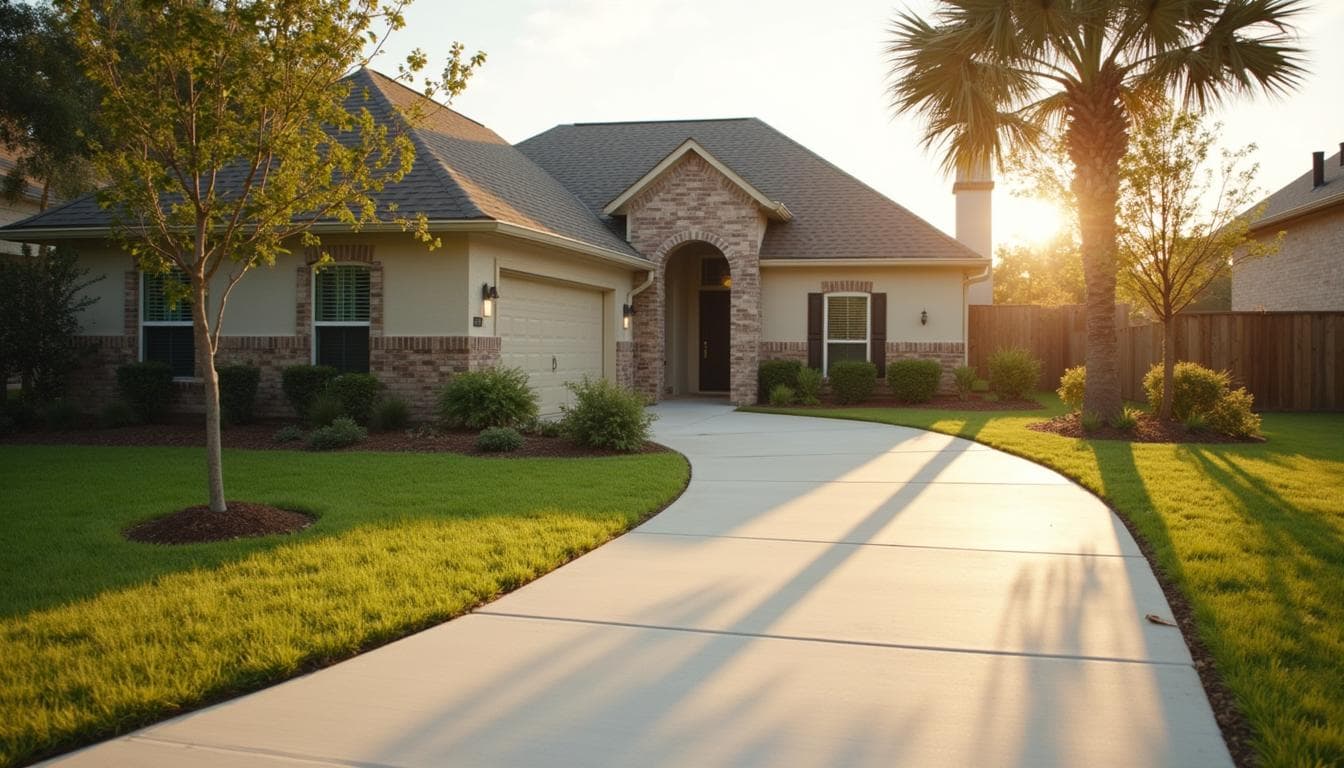
A buyer forms an impression of your house in the time it takes to walk from the car to the door, and the listing photo does the same job in about one second of scrolling. Both of those judgments happen entirely outside the house.
If your photos are days away and the budget is finite, the order you spend in matters more than the total. Here is the order, based on what changes the photograph and the walk-up most per dollar.
1. The driveway and the front walk
This is the largest single surface in most listing photos and it is almost always the dirtiest. A slab that has gone grey-green reads as neglect on the whole property, and it reads that way in a thumbnail where nothing else is legible.
It is also the cheapest dramatic change available. Cleaning concrete costs a fraction of anything involving materials or plants, and the difference is total rather than subtle. If you do one thing, do this.
2. The front elevation of the house
Not the whole house — the elevation in the photograph. Soft washing the front and the shaded side removes the mildew streaking that makes siding look aged. Pay particular attention to soffits, gutter faces, and the entry surround, because those frame the front door and the front door is where the eye lands.
Gutter face brightening deserves a specific mention here. The vertical tiger striping on white gutters runs the entire width of the photo, right along the roofline. Removing it is a modest line item with an outsized effect on how new the house reads, and a standard house wash mix does not touch it.
3. The lawn, cut twice
One cut before photos is standard. Two is better, and the second one is what makes it look maintained rather than mowed. Cut a week out, then again the day before, with hard edging along every concrete run both times.
The edge work is the part that photographs. A crisp vertical line where turf meets driveway reads as care in a way that the mow itself does not. If the lawn is genuinely overgrown, understand that it cannot go to finished height in one pass without browning — a real reset is staged over two visits several days apart, so start earlier than you think.
4. Beds: edge and mulch, do not plant
Fresh mulch and a cleanly re-cut bed edge deliver most of the visual benefit of new landscaping at a small fraction of the cost, and they do it immediately. New plants, by contrast, look new — sparse, small, and obviously just installed — and they will not fill in before closing.
Pull the grass that has run into the beds, re-cut a defined edge, lay three inches of mulch, and stop. If a bed is genuinely empty, a few larger container plants beat a dozen small ones.
5. Fence and deck, if they are in frame
A grey fence makes a whole back yard look tired, and restoration on wood is the most dramatic before-and-after in this trade because the grey layer is only a fraction of a millimeter deep. If the back yard is a selling point, this is worth it.
One timing constraint: if you want it sealed, that requires a second visit after a 48-hour-plus dry window, and in our humidity that window can be hard to find. Cleaning and brightening alone still transforms it. Start earlier if sealing matters.
What to skip
Roof cleaning, unless the streaking is severe and visible in the primary photo. It is a real improvement, but the roof is a small share of most listing images and a soft wash keeps clearing for weeks after the work — which is the wrong timeline for a Thursday shoot.
New plants, as above. Anything structural, which will be found in inspection regardless and is a negotiation item rather than a photograph. And painting anything you cannot finish properly, because a half-painted trim line photographs worse than weathered trim.
The timeline
Working backwards from photo day: bed and mulch work and the first mow at seven to ten days out. Fence and deck cleaning around then too, so a seal has a chance at a dry window. Concrete and house washing at three to five days out — far enough to be dry and settled, close enough that nothing regrows. Second mow and edge the day before. Photos.
The one thing that ruins this schedule is discovering on Tuesday that the yard needs a staged reset. If the lawn is badly overgrown, call about it first.