
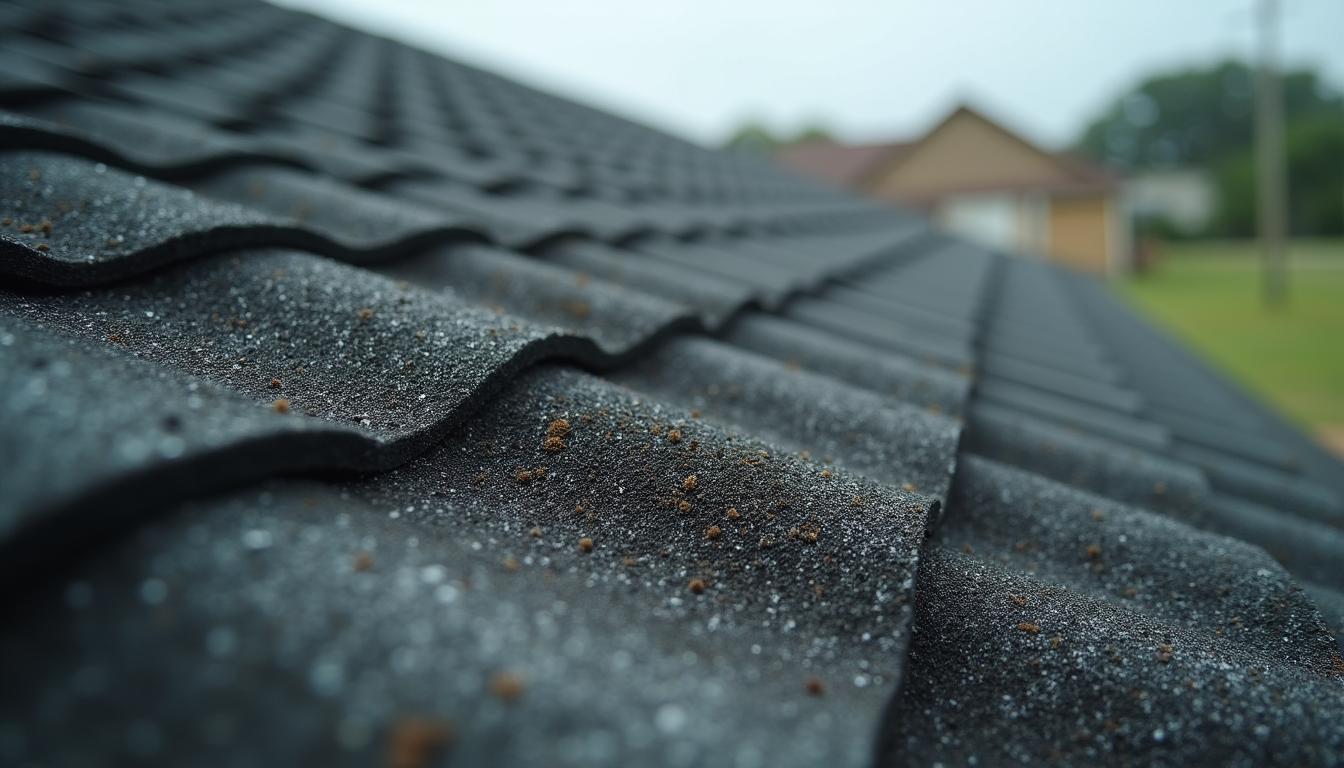
If your roof has dark streaks running down the slope, you do not have a dirty roof. You have a colony. The organism is a cyanobacteria called Gloeocapsa magma, it feeds on the limestone filler in asphalt shingles, and in a climate as humid as the Coastal Bend it is nearly universal on any roof past about eight years old.
That distinction matters, because it determines which of two very different approaches is correct — and one of them will quietly cost you several years of roof life.
What pressure actually does to a shingle
An asphalt shingle is protected by a layer of ceramic granules embedded in asphalt. Those granules are the roof's UV shield. They are the reason a shingle lasts twenty-five years instead of five, and they are not replaceable.
High-pressure water knocks them loose. So does a stiff brush. So, to a lesser but real degree, does walking on hot shingles. The damage is not visible from the ground the day it happens — the roof looks dramatically better, because the streaking is gone along with the top of the shingle surface. What you find out later is that a roof stripped of granules weathers much faster, and the failure shows up as a leak years before it should have.
If you look closely at a shingle after a pressure wash, you can often see granules in the gutter and on the driveway. That is your roof's service life, in a pile.
What soft washing does instead
Soft washing applies a dilute sodium hypochlorite solution at low pressure — under 100 PSI at the shingle, which is less than a garden hose with a nozzle — lets it dwell for fifteen to twenty minutes, and rinses gently. The chemistry kills the organism. Water only delivers it and carries it away.
This is the method the asphalt shingle industry itself recognizes, and it has a second advantage beyond not destroying your roof: it lasts substantially longer. Blasting removes the visible colony and leaves the spores, so the streaking returns quickly. Killing the organism means it has to re-establish from scratch. In practice that is the difference between a roof that streaks again in a season and one that stays clear for three to five years.
The part that surprises people
A soft-washed roof does not look finished the moment the crew leaves. Some clearing is immediate, and the rest continues over the following days and weeks as the dead colony weathers off in the rain and sun.
This trips up homeowners who were expecting an instant transformation, so any honest company should say it in advance and take before photos. If you are comparing quotes and one company promises a spotless roof by the end of the afternoon, they are describing pressure washing whether or not they use the word.
When you should not clean your roof at all
If your shingles are curling at the edges, brittle, or shedding granules on their own, cleaning is money spent on a roof that needs replacing. A wash will not extend the life of a shingle that is already at the end of it, and the handling involved may shorten it.
Any company willing to tell you that has just talked itself out of a job, which is a reasonable signal about how they will treat you on everything else.
What to ask before you hire anyone
Four questions sort the field quickly. What PSI will you use at the shingle? Will you brush or agitate the surface? How will you protect the plants under the drip line? And will you flush the flashing, valley metal, and gutters afterwards so no solution sits on metal?
The answers you want are: under 100, no, soak them before and rinse them after, and yes. Anyone who cannot answer the first question with a number should not be on your roof.