
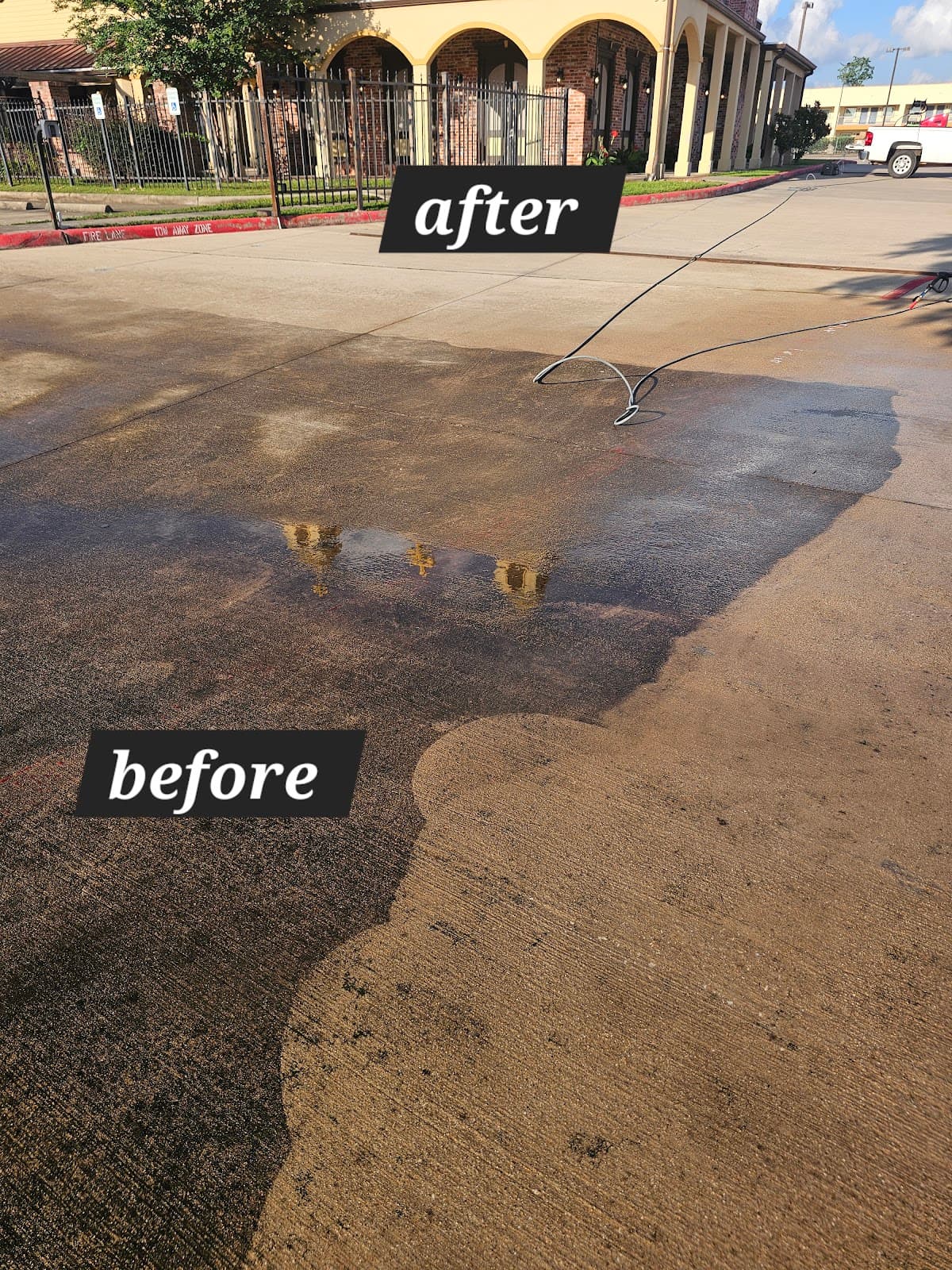
Everyone in the Coastal Bend has done this: dragged the hose out, sprayed the driveway for twenty minutes, and gotten a wet driveway that is exactly the same color it was before. The reason is that you were not cleaning dirt.
Concrete here does not get dirty so much as it gets colonized. Algae, mildew, and lichen establish in the pore structure of the slab and grow continuously. What you are looking at is alive, it is anchored, and water pressure alone will not move it without taking part of the slab with it.
Why this region in particular
Three conditions have to line up for biological growth on concrete, and we have all three for most of the year. Moisture: our humidity means a shaded slab may never fully dry. Warmth: nights stay warm enough for growth roughly eight months a year, so there is no real dormant season. And shade: live oak canopy across older Corpus Christi, Calallen, and Flour Bluff neighborhoods keeps the sun off the slab all day.
That is why a driveway in Calallen under mature canopy greens up faster than an identical slab in an open Robstown lot fifteen minutes away. It is also why the north side of anything is always worse.
The mistake that makes it come back faster
You can remove biological growth with pressure alone, but only at a PSI high enough to also remove the top layer of cement paste. That leaves a slab that is visibly cleaner and permanently rougher.
Rough concrete has more surface area, holds more moisture, and gives the next colony better purchase. So the slab regrows sooner and looks worse when it does. Every subsequent cleaning gets harder, and the pattern accelerates. A slab that has been etched by too much pressure will need cleaning noticeably more often than one that was cleaned with chemistry.
What actually works
Chemistry first, pressure second, and a surface cleaner rather than a wand. A sodium hypochlorite solution with surfactant, applied at low pressure and given five to ten minutes to dwell while kept wet, kills the organism. Then a rotary surface cleaner — an enclosed head with jets rotating at a fixed height above the slab — provides even coverage at consistent standoff so the whole area gets identical treatment.
That last part is why professional results look different. A wand cleans in a stripe, and slightly wrong overlap across a forty-foot driveway leaves zebra striping that is visible from the street for years, because the stripes are differences in surface texture rather than in cleanliness. It cannot be fixed without resurfacing. It is the most reliable signature of an amateur job in this trade.
What will not come out, honestly
Biological growth, general grime, mud, pollen film, leaf tannin, and most tire marks come out completely. Old oil, rust from fertilizer or metal furniture, red clay staining, and paint overspray improve substantially but usually do not vanish — they are in the pore structure rather than on the surface.
There is also a category people misread entirely: hard water spotting from sprinkler overspray. That is mineral deposition, not organic growth, and neither bleach nor more pressure will touch it. It needs an acid-based treatment. Knowing the difference saves you from paying twice for the wrong approach.
How often
Most Coastal Bend properties look right on an annual cycle. Heavily shaded slabs and north-facing surfaces that stay damp can need it at eight to ten months. If yours seems to need it more often than that, the previous cleaning may be the reason.